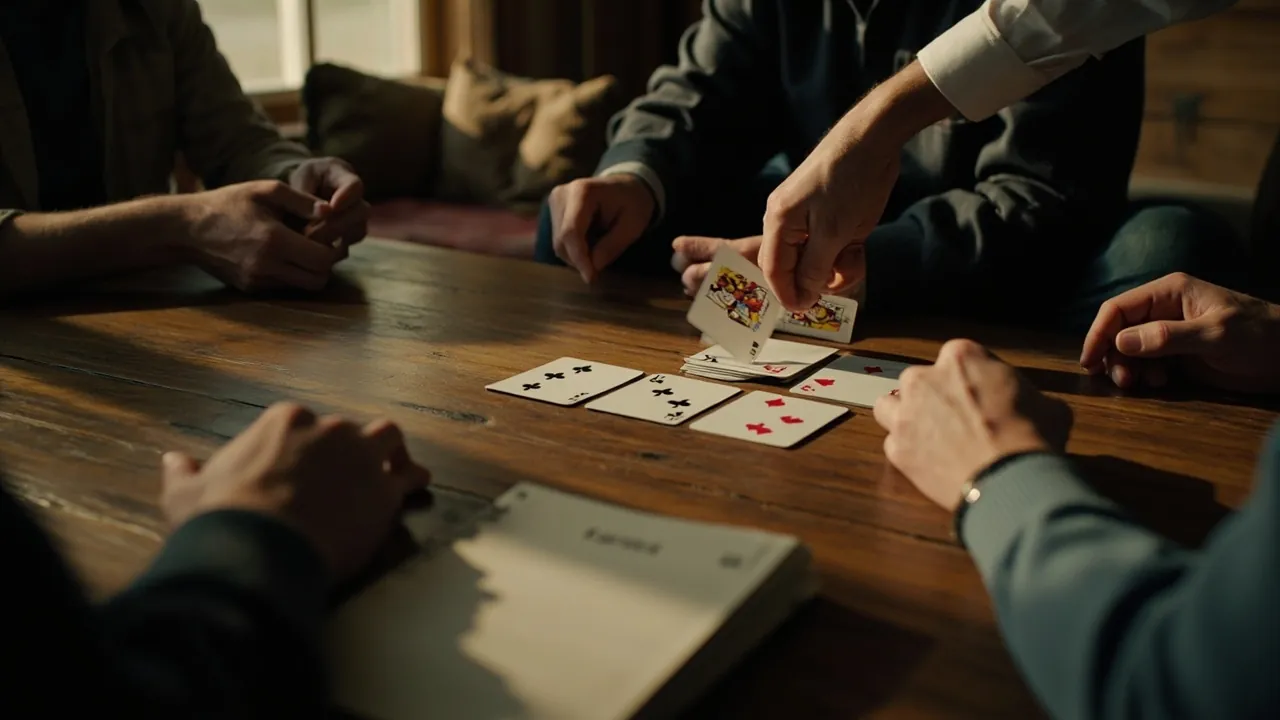
Format 01
Points Pool · 201 points
Players play until one or more reach the agreed cap, usually 201. Cards carry face-value points; jokers and unmatched cards count against the player who misses the declaration.
 Photo · Warm daylight · 4:3
RULES · STRATEGY · SAFETY · RESPONSIBLE PLAY
Compare rules across formats, study the strategy boundaries that decide winning hands, and read the platform usability notes from real sessions. The almanac covers thirteen-card Indian rummy, Points Pool, Deals 201, plus payment verification and the support resources that keep play responsible.
Four pillars
Rules and reading checklists come first, then probability boundaries and platform usability notes. Safety and responsible-play surfaces appear before any commercial block.
Meld composition, declaration, drop rules, and reading checklists for thirteen-card and pool formats.
Pure versus impure sequences, expected-value boundaries, and the limits of card-counting reasoning.
Real session notes on lobby design, draw-and-discard latency, and table performance marks.
Payment verification, age notices, jurisdiction notes, and helpline resources written for adult readers.
Rules chapter
A valid declaration requires at least one pure sequence (no joker) and a complete set of remaining cards arranged into valid sequences or sets. The annotated diagram below walks through the same hand with the three call-outs you can repeat on any felt.

Three or more consecutive cards of the same suit with no wild or printed joker substituted. Every valid declaration needs at least one.
A consecutive run built using a joker as a substitute card. Useful for completing sequences but cannot replace the pure sequence you still need.
Three or four cards of the same rank across suits. A four-of-a-kind set with jokers carries higher point weight in most pool formats.
Points ledger
The ledger below uses the most common Indian-rummy scoring convention. Verdict chips reflect how the cards read once the hand is declared or dropped. Values are illustrative; your platform's published table is the authoritative source.
| Combination | Composition | Joker used? | Card value on miss | Verdict |
|---|---|---|---|---|
| Pure sequence | 3+ consecutive cards, same suit | No | Face = 10 · Ace = 10 · Numbered = face value | Required |
| Impure sequence | 3+ consecutive cards, mixed or with joker | Yes (or mixed suits) | Same as pure; joker value = 0 | Permitted |
| Set | 3 or 4 cards of the same rank | Optional, only in 4-card set | Same face/numbered scale | Optional |
| Ungrouped card | Single high-value unmatched | — | Counts against declarer on miss | Risk |
| First-drop bonus | Drop before third draw | — | Lower penalty than mid-game drop | Tactical |

Format gallery
Most platforms catalogue at least these two formats. Points Pool rewards careful joker planning across many hands; Deals rewards reading a single thirteen-card hand thoroughly. Each format has its own rhythm.
Players play until one or more reach the agreed cap, usually 201. Cards carry face-value points; jokers and unmatched cards count against the player who misses the declaration.

Each player is dealt thirteen cards. A pre-agreed number of deals (commonly three) determines the winner; chips track results rather than running points.

A shorter variant on the same mechanics. Some platforms offer both 101 and 201 cap rooms; pool rooms often run faster and host more rounds per hour.
Probability overlay
Hover the photograph to read the editorial caption. The reasoning column lists the three observations a careful reader makes in the first minute of any dealt hand.
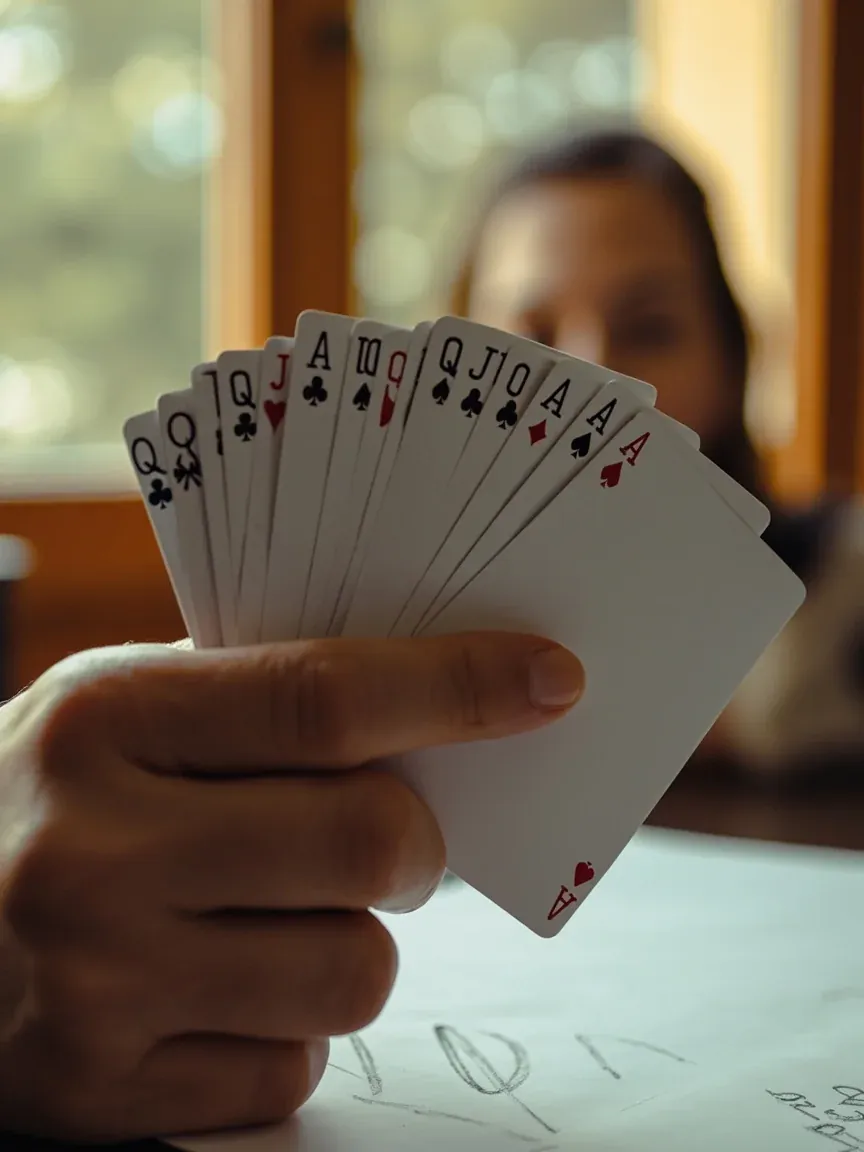
Evidence desk
Each tab opens a short editorial panel: a verdict chip, an evidentiary note, and a footnote list. The desk recurs in the strategy hub with probability and platform-readability tabs.

A joker substitutes a card in any impure sequence or four-card set, but cannot replace the missing card inside your required pure sequence. Treat each joker as one decision: where it earns the most combinations across the rest of your hand.

Most platforms score a first-drop well below a mid-game drop. If your dealt hand lacks any path to a pure sequence by the third draw, a first-drop is usually the cheaper choice than continuing.

Probability reasoning improves the consistency of your decisions but cannot eliminate variance. Treat any third-party system promising a winning rate as a marketing claim, not a method.
Platform usability
Hover the photograph to read the three performance marks an adult reader can record during a single table session. None of them require a published benchmark; each is observable inside one sitting.

Payment and verification
Verification is a documented process, not an optional step. The ledger below describes the three rows you can expect to encounter on a regulated platform, regardless of brand.
A regulated platform never stores your full card number or PIN; the table above describes the documented process rather than a single brand.

Responsible play
Skill games are for adults. If a session ever stops feeling like a choice and starts feeling like an obligation, the resources below are independent of any platform or brand.
Set a session budget before you sit down. Treat a deposit as the cost of entertainment, not as a stake to be won back. If a session is no longer a calm decision, the resources below answer in your language, free of charge.

Rummy newsroom
Briefings are short and dated. They cover platform-level announcements an adult reader needs to know — lobby changes, verification flow updates and tournament-format adjustments.

Points Pool, Deals 13-card and tournament variants share the hand but change the scoring surface, cap and pace.
An update to the table-stake selector visible above the fold on common mobile widths. No change to scoring rules or to verification flow.
Platform-led self-exclusion reminders now default to a fixed cadence during play. The change is configurable inside responsible-play settings.
Operators have published a documented Deals-room rotation schedule across prime-time hours, intended to reduce lobby congestion on weekend evenings.
Reader questions
The reader-questions desk collects questions adult readers ask the editorial team. Each answer is short, factual and footnoted. Where a question has no verifiable answer, the desk says so.

Is rummy a game of skill or chance?
The Supreme Court of India has repeatedly held rummy to be a game of skill, predominantly. State-level restrictions remain in force in some regions; the desk cannot speak to your local rules.
Footnote: published case law references are linked from the responsible-play hub.
How many formats does a typical platform host?
Most regulated platforms host at least Points Pool 101, Points Pool 201, Deals 13-card and a tournament rotation. Some add speed variants.
Footnote: format-specific rules are published inside each platform's lobby help.
What is a fair first-drop rule?
A first-drop is the lowest scoring penalty a platform offers for leaving a hand before the third draw. Adult readers should check the published table before assuming the value.
Footnote: see the points ledger on this page for a generic convention.

Sourcing standards: this almanac cites platform-published rules, regulatory references and editorial commentary. No payment, login or identity claim is invented.
Editorial standards: each hub page passes a word-count, image-coverage and tone audit before publication. The desk welcomes corrections by post.
Adult readers only · 18+. Play is voluntary. Support is independent.
The full format catalogue covers thirteen-card mechanics, pool scoring, deals rotation and tournament reads — written for adult readers who want the rules once, correctly.